
Production Companies
If you're an operator with your own wells and you want in-house CT capability, a trailer unit is the most affordable way to start. No need to hire a service company for every small intervention job.
A trailer mounted coiled tubing unit sits between a skid unit and a full truck unit on the cost spectrum. You get mobility —tow it with a standard prime mover —without the cost and complexity of an integrated truck chassis. Perfect for smaller CT sizes (1-1/4" to 2"), light intervention work, and operators who want to own their own CT capability without the big capital outlay. If you're just getting into coiled tubing, or your jobs are mostly well flushes and scale removal, this is where the value is.
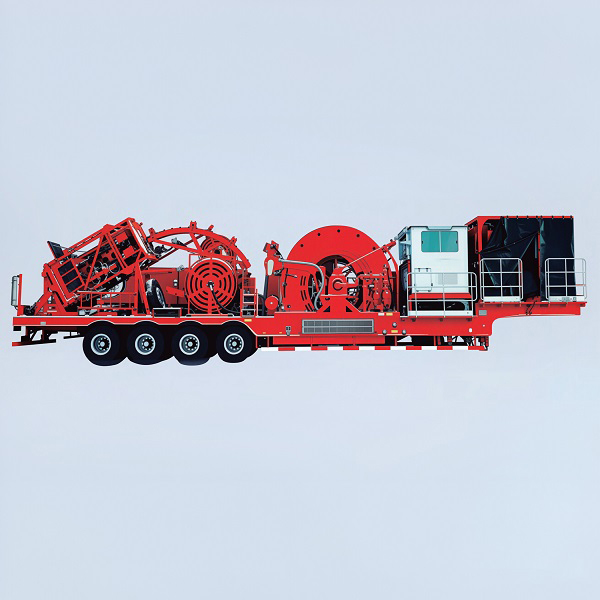
Skid, trailer or truck —each has its place. Here's how they compare:
| Mount Type | Relative Cost | Mobility | Best For |
|---|---|---|---|
| Skid Mounted | Lowest | None (needs crane/flatbed) | Offshore, fixed locations |
| Trailer Mounted | Medium | Tow with prime mover | Light intervention, cost-conscious operators |
| Truck Mounted | Highest | Self-propelled, fastest rig-up | Service companies, multi-well campaigns |
The trailer option hits the sweet spot for many operators: you get mobility without paying for the full truck chassis, engine and transmission. The trade-off is that you need a separate truck to tow it —but most oilfield operators already have prime movers on location anyway.
If you're an operator with your own wells and you want in-house CT capability, a trailer unit is the most affordable way to start. No need to hire a service company for every small intervention job.
Newer CT service companies often start with a trailer unit. Lower capital outlay means you can start generating revenue sooner. Upgrade to a truck unit once the business grows.
If most of your work is well flushing, scale removal, or through-tubing logging —not heavy milling or large CT sizes —a trailer unit has more than enough capability.
| Parameter | Typical Range |
|---|---|
| Tubing OD | 1-1/4" - 2" (light to medium service) |
| Injector force | 40,000 - 80,000 lbs (18 - 36 tonnes) |
| Reel capacity | 3,000 - 5,000 m (9,800 - 16,400 ft) |
| Power pack | 200 - 400 HP diesel |
| Trailer type | Tandem or triple axle, air brakes |
| Towing truck required | Class 8 prime mover (typical 400+ HP tractor) |
Most trailer CT units weigh between 15 and 30 tonnes depending on the size of the reel and power pack. You'll need a Class 8 prime mover (typically a 400+ HP diesel tractor) with appropriate towing capacity. If you're working in a country with specific road transport regulations, check local weight limits and permit requirements. Many operators use the same prime movers they already use for other oilfield trailers.
For smaller CT sizes (up to 2" OD), yes —the injector, reel and BOP are essentially the same equipment. The difference is in rig-up speed and mobility. A truck unit can be on location and working within a couple of hours. A trailer unit needs to be towed in, parked, leveled and connected —add 1-2 hours. For light intervention work, the extra rig-up time is usually not a deal-breaker.
Maintenance is similar to any CT unit —the injector, reel and power pack need the same routine service. The trailer itself adds annual axle inspections, brake service and tire replacement. Because the trailer has no engine of its own, there's less complexity to maintain compared to a truck-mounted unit. Many operators find trailer units slightly cheaper to maintain long-term.
Tell us your required tubing size, injector force and towing truck availability. We'll recommend the right trailer configuration and provide a quote.