
Heavy-Duty Dust Filtration
Multi-stage air filtration for engines and air systems. Primary filter, secondary filter, and safety filter. Pre-cleaner for heavy dust environments. Filters are designed for easy changeout in dusty conditions.
Drilling in the desert is different from drilling anywhere else. Temperatures hit 50°C+. Sand gets into everything: air filters, radiators, bearings, seals. Water is scarce —you can't waste it on mud or cooling. The ground is soft sand, not hard rock —standard rigs sink. Access roads don't exist; you move across dunes. A standard drilling rig will overheat, clog with sand, and get stuck in the desert. A desert drilling rig is engineered for these conditions: heavy-duty dust filtration, high-temperature cooling systems, water-conservation mud systems, wide tires or tracks for soft sand, and crew quarters with climate control. We design and build desert drilling rigs for operations in the Middle East, North Africa, Central Asia, and the arid regions of China.
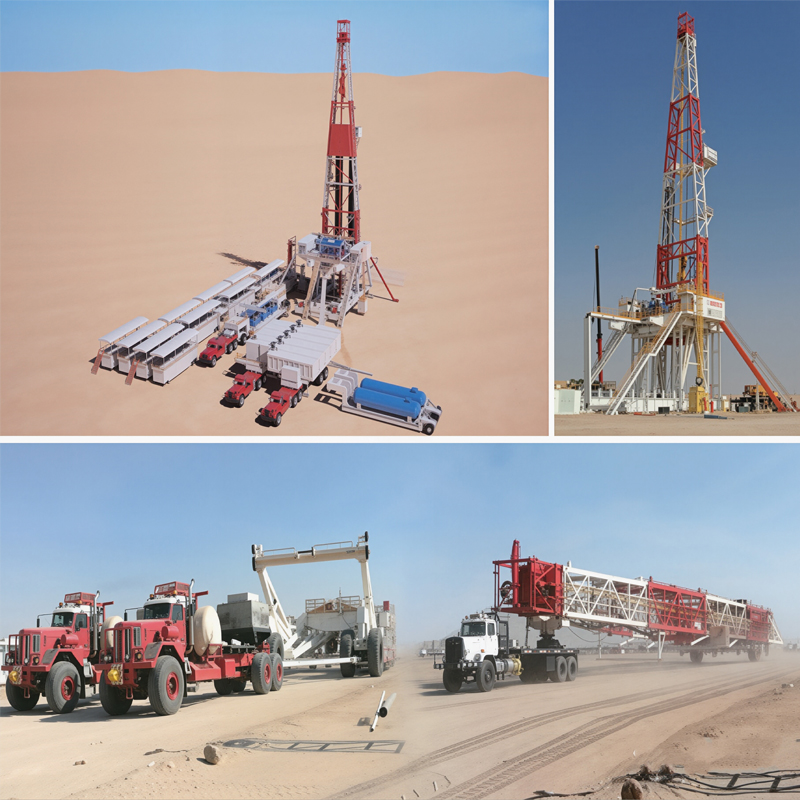
Desert conditions attack every system on the rig:
| Challenge | Problem | Desert Rig Solution |
|---|---|---|
| High Temperature (50°C+) | Engine overheating, hydraulic oil overheating, electronics fail | Oversized cooling system, high-temp hydraulic oil, shaded engine compartment |
| Sand & Dust | Air filters clog fast, sand gets into bearings and seals | Heavy-duty air filtration (multiple stages), sealed enclosures, dust exclusion |
| Water Scarcity | Can't use water-based mud freely; cooling water is limited | Water-conservation mud system, closed-loop cooling, water storage tanks |
| Soft Sand Ground | Rig sinks, can't move on soft sand | Wide tires or crawler tracks, ground mats, low ground pressure design |
| Remote Location | No power grid, no roads, limited supply | Self-contained power, large fuel storage, spare parts inventory on board |
Multi-stage air filtration for engines and air systems. Primary filter, secondary filter, and safety filter. Pre-cleaner for heavy dust environments. Filters are designed for easy changeout in dusty conditions.
Oversized radiators and cooling fans rated for 50°C ambient. High-temperature coolant. Engine compartment shading and ventilation. Hydraulic oil coolers sized for extreme ambient heat.
Closed-loop mud system that recycles water. Large water storage tanks (50-100 m³). Air drilling or low-water mud options where water is extremely scarce.
Wide tires (or crawler tracks) for soft sand. Low ground pressure. Self-propelled movement across dunes without road access. Optional ground mats for rig setup on soft sand.
Our standard desert package is rated for 50°C (122°F) ambient temperature. This includes oversized cooling systems, high-temperature fluids, and heat-shaded enclosures. For more extreme environments (55°C+), we offer an upgraded arctic/desert extreme package with additional cooling capacity and heat shielding. Tell us your maximum ambient temperature, and we'll specify the right cooling system.
Desert rigs use either wide low-pressure tires (for moderate sand) or full crawler tracks (for deep dunes). The rig is designed with low ground pressure so it doesn't sink in soft sand. For very soft ground, we use portable ground mats that the rig moves over. Tell us your terrain conditions (sand type, dune height, ground hardness), and we'll recommend the right mobility configuration.
Water consumption depends on the mud system. With a standard water-based mud system, a drilling rig might use 50-100 m³ of water per day. With a water-conservation closed-loop system, this can be reduced to 20-30 m³ per day. With air drilling (where appropriate), water consumption is near zero. We provide large water storage tanks on the rig, and we can design the mud system to minimize water usage based on your local water availability.
Tell us your operating environment (temperature range, sand conditions, water availability, terrain). We'll design a desert drilling rig package —dust-protected, heat-resistant, water-conserving, and mobile across soft sand —built for your specific desert conditions.