
1. Positioning
The jack up rig floats or is towed (or driven on tracks) to the well location. In shallow water, the hull floats. On land, the rig sits on tracks or wheels.
What do you do when the well is in a marsh, a shallow lagoon, a floodplain, or soft ground that can't support a conventional rig? You use a jack up drilling rig. Four (or more) legs lower to the seabed or ground, then the whole drill floor elevates above the water or mud level. Suddenly you have a dry, stable drilling platform where there used to be swamp water. This is the standard solution for onshore wetland operations, delta exploration, and transition zone drilling.
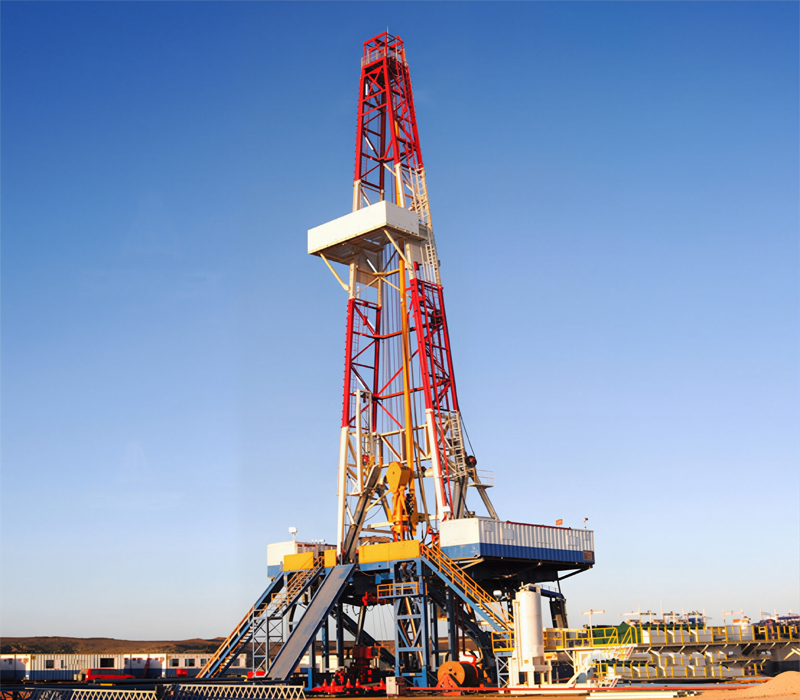
The principle is simple: legs down, platform up. Here's the process:
The jack up rig floats or is towed (or driven on tracks) to the well location. In shallow water, the hull floats. On land, the rig sits on tracks or wheels.
The legs (spud cans or piles) are lowered until they hit the seabed or ground. The hydraulic or rack-and-pinion jacking system then pushes the legs deeper until they're firmly anchored.
Once the legs are set, the jacking system lifts the entire drill floor above the water level (or soft ground). The rig is now a stable, dry platform for drilling.
With the platform elevated, you drill exactly like a conventional land rig. The mud system, BOP and crew all work from the elevated deck.
Delta regions like the Mississippi, Niger, or Mekong. Shallow water and soft mud make conventional rigs impossible. Jack up rigs are the standard solution.
From 0 to 5 meters water depth. Deeper than a land rig can handle, too shallow for a big offshore jack up. This is the sweet spot for land-type jack up rigs.
Areas that flood seasonally. The rig elevates above flood level. You don't have to wait for dry season to drill. Year-round operation.
| Parameter | Typical Range |
|---|---|
| Water depth capability | 0 - 8 m (0 - 26 ft) for land-type jack up rigs |
| Elevated platform height | 2 - 6 m above water/ground level |
| Number of legs | 4 (standard) to 6 (larger rigs) |
| Drilling depth | 1500 - 4000 m (5,000 - 13,000 ft) |
| Hook load rating | 225 - 450 tonnes |
| Leg type | Open truss legs with spud cans, or closed tubular piles |
Offshore jack up rigs are huge —they operate in 30 to 120 meters of water and weigh thousands of tonnes. They're moved by tugboats. Land jack up rigs are much smaller —they work in 0 to 8 meters of water, weigh a few hundred tonnes, and can be moved on a barge or even driven on tracks over land. The operating principle is the same (legs down, platform up), but the scale and engineering are completely different. If you're drilling in transition zone water or wetland, you need a land-type jack up, not an offshore rig.
On land, some jack up rigs are built on tracks or wheels —they drive to the next location under their own power. In shallow water, the rig is towed by workboats or pushed by tugboats. For longer moves, the legs are retracted, the rig floats (or is loaded on a barge), and it's moved to the next location. Rig-up time at the new location (legs down, platform up) is typically 1 to 2 days, depending on water depth and bottom conditions.
Modern jack up rigs minimize environmental impact because you don't have to build a road or drill pad through the wetland. The rig stands on its legs, and operations are contained on the elevated platform. Mud and cuttings are contained in tanks on the platform. Many environmental agencies prefer jack up rigs over conventional rigs for wetland drilling because the footprint is smaller and you don't disturb the wetland soil. We can also design spill containment and zero-discharge systems for sensitive areas.
Tell us your maximum water depth, required drilling depth and bottom conditions (mud, sand, rock). Our engineering team will design a jack up rig that fits your operating environment.