
High Pressure Gate Valves
Full-bore gate valves rated to match the BOP stack pressure. These open and close the kill line. They're used to isolate the kill line when not in use, and to redirect flow during different well control procedures.
When a well kick happens, you don't just close the BOP and walk away. You have to kill the well —pump heavy kill mud into the wellbore to balance formation pressure. The kill manifold is the critical piece of equipment that makes this possible: it connects your mud pumps (or cementing unit) to the well's kill line, so you can pump high-density kill fluid at high pressure into the well. It sounds simple, but the valves, check valves and connections have to hold full well pressure while you're pumping thousands of liters of heavy mud. A failed kill manifold during a well control event is the difference between a managed kill and a blowout.
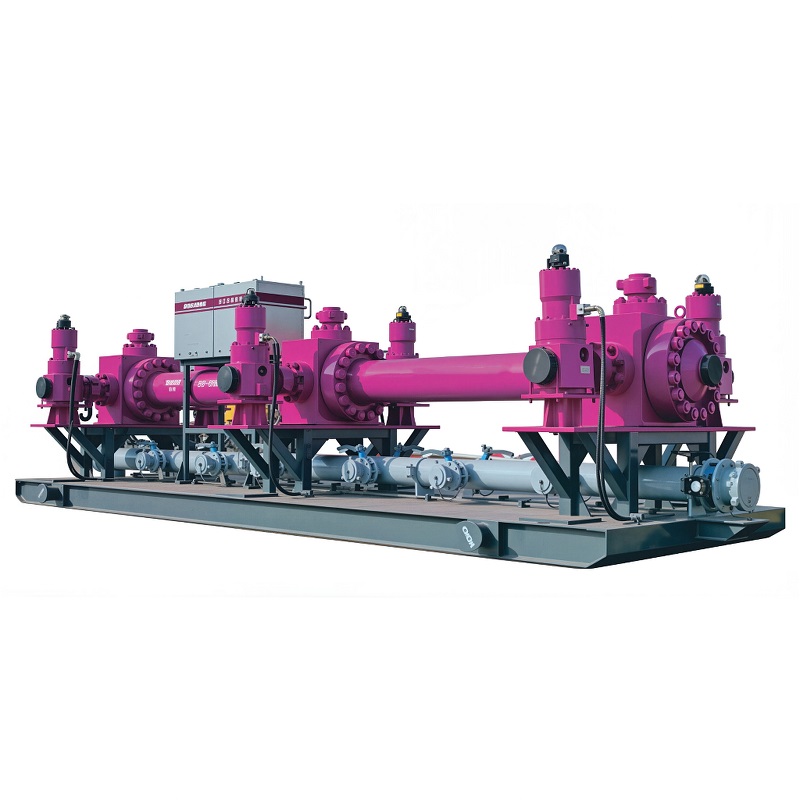
A kill manifold isn't just a few valves bolted together. It's a purpose-built well control assembly:
Full-bore gate valves rated to match the BOP stack pressure. These open and close the kill line. They're used to isolate the kill line when not in use, and to redirect flow during different well control procedures.
Critical safety component: a check valve that prevents well fluid from flowing back out through the kill line. If well pressure surges, the check valve closes automatically, protecting your pumps and surface equipment from backflow.
Inlet ports for connecting to mud pumps, cementing unit, or kill line from the rig. Outlet ports connecting to the BOP stack's kill line. Usually 2-4 inlet connections for redundancy.
Pressure gauges on the manifold show the operator what pressure they're pumping against. This is critical for monitoring the well kill procedure —you need to know the bottomhole pressure relationship in real time.
There are several standard well kill procedures, all using the kill manifold:
| Method | How It Works | Kill Manifold Role |
|---|---|---|
| Driller's Method | Circulate kick out with original mud weight, then weight up in second cycle | Low pressure during first cycle, higher during second |
| Engineer's Method (Wait & Weight) | Pump kill mud down, displace annulus in one cycle | Higher pump rate, continuous kill mud injection |
| Weight & Bullhead | Pump kill mud directly into the well, no return flow | Highest pressure —bullheading against closed well |
| Lubricate & Bleed | Batch injection of kill mud, small volumes at a time | Intermittent pumping, precise pressure control |
| Parameter | Typical Range |
|---|---|
| Pressure rating | 3,000 - 15,000 psi (21 - 105 MPa) |
| Number of valves | 4 - 8 gate valves (depending on configuration) |
| Inlet connections | 2 - 4 x 2" - 3" flanged outlets |
| Outlet connection | 1 x 2" - 3" connection to BOP kill line |
| Standard | API 16C (drilling well control fluid control equipment) |
| Material | Forged alloy steel (AISI 4130 / 4140), NACE option for sour service |
They do opposite things. The kill manifold pumps fluid INTO the well (heavy kill mud). The choke manifold controls fluid flowing OUT of the well (mud and formation fluid during the kick). In a well kill operation, you use both: pump kill mud in through the kill line (kill manifold), and control the outflow through the choke line (choke manifold). They're two sides of the same well control process. Most rigs have both, often integrated into a single combined choke & kill manifold system.
Yes. Cementing units are high-pressure, high-rate pumps —exactly what you need for well kill operations. In fact, on many workover and completion rigs, there's no dedicated mud pump. The cementing unit doubles as the kill pump. This is why cementing units have high-pressure connections rated for well service. If you're running a cementing unit on location, you're already carrying well kill capability with you.
The kill manifold pressure rating must match your BOP stack rating. If your BOP is 10,000 psi, your kill manifold should also be 10,000 psi. The whole well control system (BOP + choke manifold + kill manifold + control system) should be rated for the same maximum well pressure. Mixing ratings is dangerous and not API-compliant. Tell us your BOP stack pressure rating, and we'll supply a matching kill manifold.
Tell us your BOP stack pressure rating, required number of pump connections, and whether you need sour service (NACE) rated. We'll supply an API 16C certified kill manifold that matches your well control system.