
1. Suction from Mud Pit
The pump draws mud from the suction pit (the active mud system). Mud has been conditioned (mixed, weighted, treated) and is ready to go downhole.
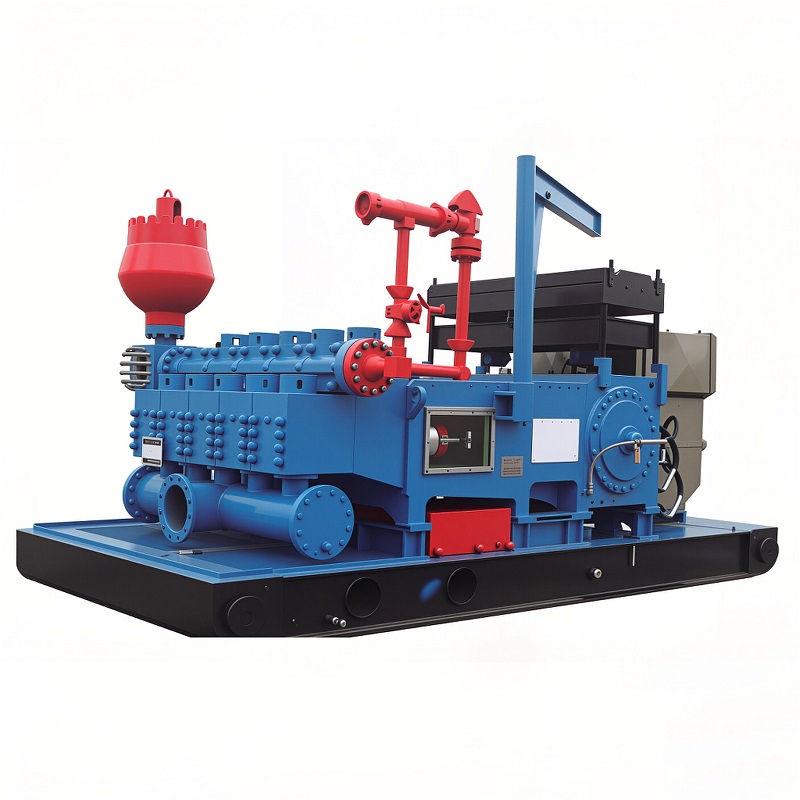
Drilling mud isn't just water —it's a carefully engineered fluid with bentonite, polymers, barite, and rock cuttings suspended in it. The mud circulation pump has to push this abrasive, solids-laden fluid down the drill pipe, back up the annulus, and through the solids control equipment —thousands of times a day, for weeks on end. It's not a clean water pump. Every component that touches the mud (liners, pistons, valves, seats) is a wear part. The pump is sized to match the hole size, depth, and desired flow rate —get it wrong and you can't clean the hole effectively, which slows drilling and risks stuck pipe. This is why the mud pump is called the heart of the rig.
Mud flows in a closed loop around the drilling system. The pump is the driving force:
The pump draws mud from the suction pit (the active mud system). Mud has been conditioned (mixed, weighted, treated) and is ready to go downhole.
Pressurized mud is pushed down the drill pipe —through the kelly, down the string, and out through the bit nozzles. The jetting action cools the bit and cleans the bottom of the hole.
mud comes back up the annulus (the space between drill pipe and hole wall), carrying rock cuttings to the surface. The upward velocity must be high enough to lift cuttings —that's why pump flow rate matters.
At surface, mud passes through shale shakers (to remove large cuttings), desanders, desilters, and centrifuges (to remove finer solids). Cleaned mud returns to the pit, ready for the pump to send it down again.
Two main piston pump designs for drilling mud circulation:
| Triplex (3 Cylinders) | Duplex (2 Cylinders) | |
|---|---|---|
| Flow smoothness | Smoother (3 pistons, less pulsation) | More pulsation (2 pistons) |
| Size / weight | Smaller, lighter for same power | Larger, heavier |
| Typical power | 300 - 1,600 HP | 500 - 2,000 HP (older designs) |
| Modern rigs | Standard on most new land rigs | Common on older / deeper rigs |
| Maintenance | Simpler valve maintenance | More valves, more complex |
| Rig Size | Pump Power | Flow Rate | Max Pressure |
|---|---|---|---|
| 1,000m workover rig | 300 - 500 HP | 500 - 800 L/min | 3,000 - 5,000 psi |
| 2,000m drilling rig | 600 - 800 HP | 800 - 1,200 L/min | 5,000 psi |
| 4,000m drilling rig | 1,000 - 1,300 HP | 1,200 - 1,600 L/min | 5,000 - 7,500 psi |
| 7,000m drilling rig | 1,600 - 2,000 HP | 1,600 - 2,400 L/min | 7,500 - 10,000 psi |
Because drilling mud is abrasive. Rock cuttings, sand, and barite particles act like sandpaper on pump components. A standard water pump will wear out in days —the liners, pistons, and valves will be destroyed. Mud pumps are built with hardened wear components: chrome-plated liners, rubber-encapsulated pistons, and hardfaced valve seats. These are designed specifically to handle abrasive solids-laden fluid. It's a different class of pump from water transfer.
Three things determine pump size: (1) hole diameter —larger holes need higher flow rate to maintain annular velocity, (2) well depth —deeper wells need higher pressure to overcome friction losses, (3) desired penetration rate —faster drilling = more cuttings to lift = more flow. As a rough guide: a 2,000m rig typically uses a 600-800 HP mud pump, a 4,000m rig uses 1,000-1,300 HP, and a 7,000m rig uses 1,600+ HP. Tell us your well depth and hole size range, and we'll recommend the right pump size.
The parts that touch the mud are all wear items: (1) liners (the cylinder walls) —chrome-plated, replaced when worn past tolerance, (2) pistons —rubber-encapsulated, replaced every few hundred hours, (3) valve bodies and seats —hardened steel, replaced when they stop sealing, (4) valve springs —replaced when they lose tension. We recommend keeping a full set of spares on location. Mud pump downtime costs $10k+/day in rig time. Don't wait for a failure —change wear parts on schedule.
Tell us your rig class (depth rating), desired flow rate and pressure, and whether you need triplex or duplex. We'll supply a mud pump matched to your drilling operation.